If you have an online business, you've probably asked yourself a key question: why isn't my website selling enough? Perhaps you feel like you're working hard but the results aren't what you expected.
In this article, I will explain the most common reasons why a website doesn't convert, how you can diagnose what's really happening in your case, and how to find solutions to answer the question: how to sell more in e-commerce.
2 reasons and a very frustrating case
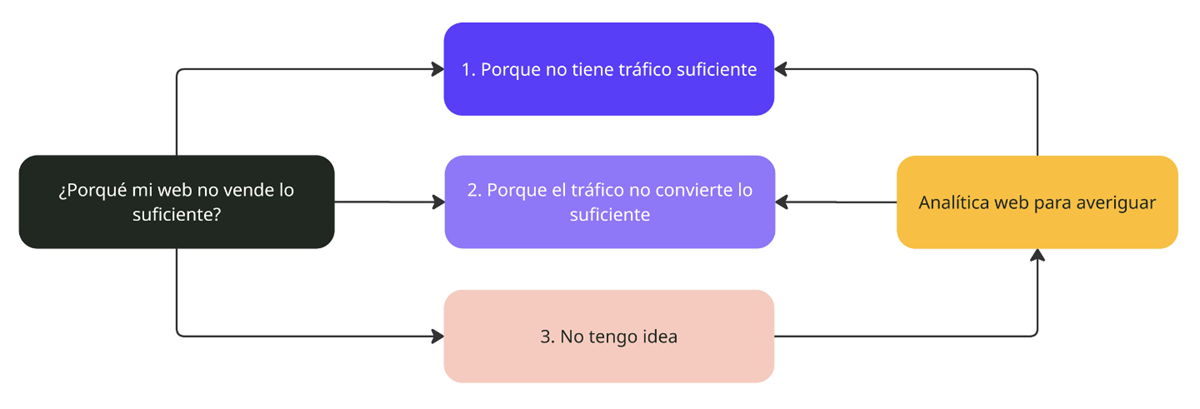
Essentially, a lack of online sales boils down to two main reasons:
The first: Your website doesn't have enough traffic. That is, not many people are reaching your product pages, service pages, articles, and landing pages in general.
The second: The traffic that reaches your website doesn't convert enough. In other words, people find your pages and enter, but they don't complete a purchase, reservation, download, or whatever conversion goal your brand is seeking.
And there is a third case, perhaps the most frustrating: you have no idea why you're not selling. Well, fortunately, this can be solved with a very useful discipline: Web Analytics.
There's no magic. Generally, the answer lies in one of these 3 scenarios. At most, it can be a mix of one and two.
Get our analysis in your inbox
Subscribe to the FREED newsletter: applied research, trends and tools.
No spam. Unsubscribe anytime.
1. Your website does not have enough traffic
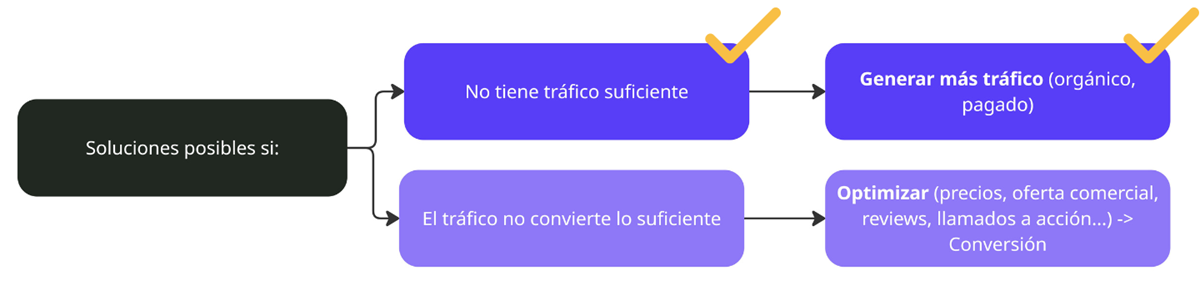
Let's see what happens if your problem is a lack of traffic. The diagnosis is evident: it's normal for a site with only 200 or 500 monthly visits not to convert or sell, as the volume of people reaching its pages is very low. If the traffic isn't sufficient, you need to do something to increase it. And the sources for growing traffic today are the same as always:
You must work on your organic ranking with an SEO strategy, creating quality content for your website that answers what your audience is looking for on Google, in relation to what you sell.
Supplement with a paid traffic strategy by running Google Ads that direct to your product pages. Be careful... good ad content and well-optimized product pages are also important here.
Use your business's social media to promote your website. If your business isn't on the social network that attracts your target audience, you're missing a great opportunity to grow your brand.
Activate an email marketing campaign using your database of current and potential customers. Tell them what your business is up to and what's new on your website. Take advantage of offering promotions and discounts that drive conversions.
All of the above is in the context of brand building work that may also involve opening new sales channels, improving the customer experience with the brand, creating an ambassador program, and other growth strategies.
Remember... There's no magic to this; it only works with constant effort and understanding what's happening, so you can apply the improvements that will help your online business grow.
2. Traffic does not convert enough
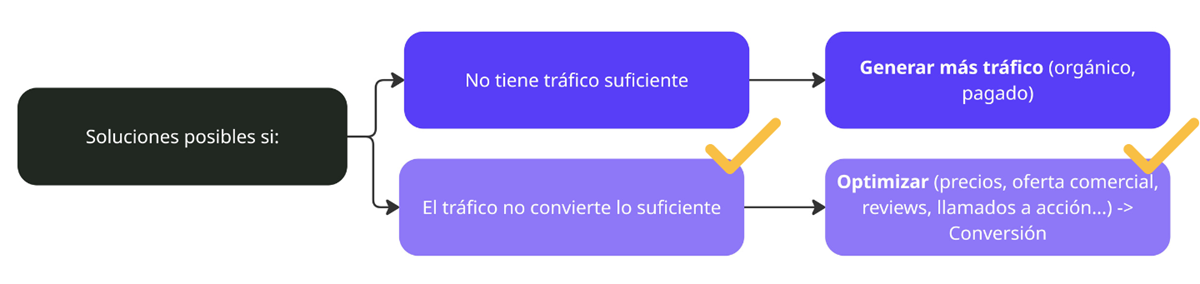
Let's move on to the second diagnosis: traffic isn't converting. In this case, the scenario is critical, and that's where web analytics becomes vital. This is when you have a high volume of traffic, for example, 10,000 monthly visits, and yet, you're not converting. Here you need to ask yourself some deep questions to address the question of how to sell more online:
Is your offer clearly understood?
Is your price appropriate?
Is your offer attractive compared to the competition?
Are you creating a need for an immediate decision?
To solve this problem, it would be ideal if you could test your website and its content with real users. This will be a very enriching opportunity because you can also ask them these questions directly. Their feedback will be of great help for you to make the necessary improvements so that your website drives conversion when potential customers reach its pages.
For example, you might discover that you need to:
correct your pricing strategy,
modify your commercial offer,
publish customer reviews,
improve calls to action, etc.
3. I have no idea
But you can also answer these questions, as well as solve the "I have no idea" case, by turning to Web Analytics.
Don't forget this... The key to continuous improvement is summarized in a fundamental phrase:
What is not measured cannot be improved. What is not improved, always degrades.
It sounds cliché, but it's the plain and simple truth. For example, if you're looking to position your brand organically, constant measurement and analysis of SEO metrics are the only way to evaluate whether your website is attracting relevant traffic and achieving the expected organic positioning.
What should we measure to diagnose conversion? We need to define our KPIs. KPI stands for Key Performance Indicator.
These indicators give you a global overview of the situation and help you identify areas where you need to make improvements. Let's look at an example.
Suppose you have a website with online sales, such as an e-commerce for products or services, like ticket sales, restaurant or hotel bookings, or course sales. We won't cover all relevant e-commerce KPIs now, but one of the most important KPIs for an online business is the Conversion Rate.
The conversion rate
Conversion is any action a visitor takes on the website that is considered beneficial to the brand's objectives.
This could be a sale, a lead, a download, filling out a form, or a subscription.
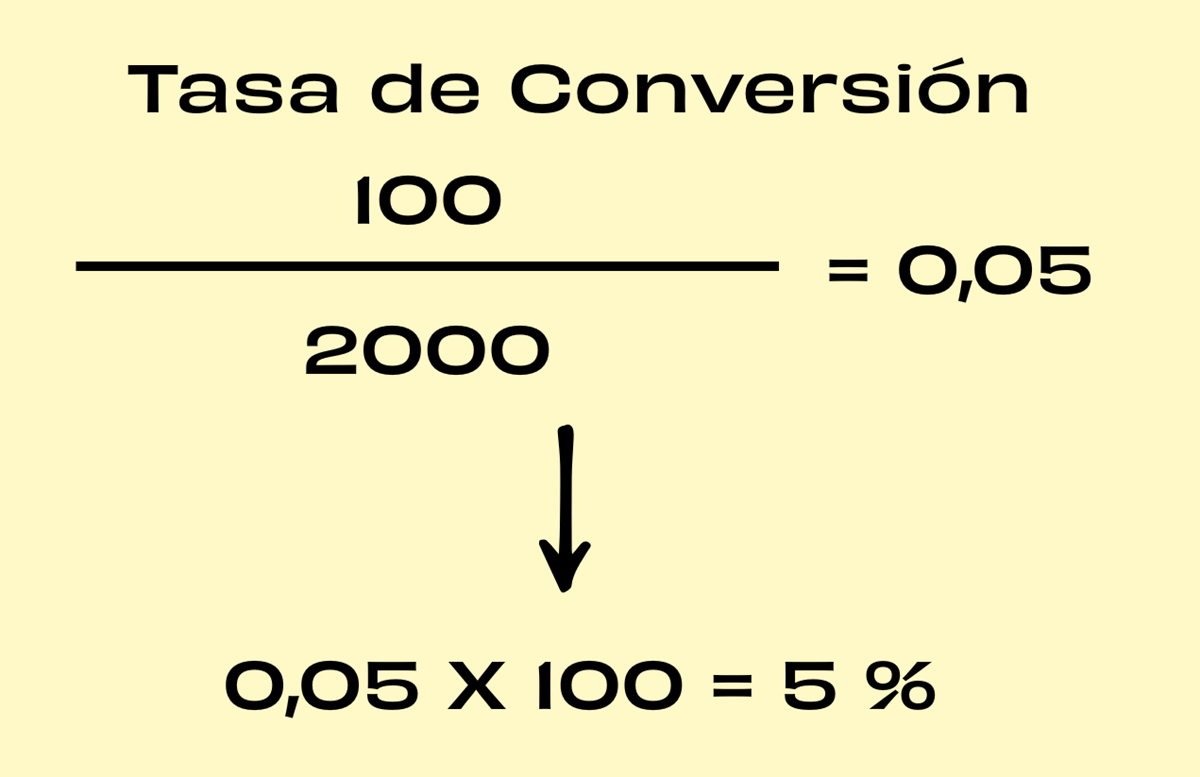
To calculate the conversion rate, you divide conversions by total visits and multiply the result by 100.
For example, if you have 2000 visits and 100 convert into sales, the rate is 5 percent.
Now, how good is this metric: 5%? Well, to have a point of comparison, you need to see how your brand performs against the rest of the industry. That's called benchmarking, and you'll find more articles on the topic in our blog. I'll leave the links at the end.
You can also watch and listen to this article in podcast format:
And why is the Conversion Rate so important?
Because constant monitoring of the conversion rate can immediately alert you that something is wrong with your website. For example, if you detect that organic traffic has dropped or the conversion rate plummeted from one week to the next. If it's the latter, for example, you should investigate:
Were recent modifications made to the website?
Did this affect usability?
To answer these questions, you can also perform tests as a real user of your website and simulate normal navigation and a purchase. This way, you might discover that a vital service, such as the shopping cart or the ability to purchase in an important category, simply stopped working.
This single example shows us how KPIs prevent significant losses and help us answer the question of how to sell more online.
You should also analyze Conversions by Traffic Sources. This will tell you how much organic traffic, social media traffic, or direct traffic contributes to your goals. With this metric, you can answer a key question: does the organic traffic obtained convert or not?
Other relevant metrics that provide information about the user experience with your website and the conversion you obtain are the Average Interaction Time and the organic CTR, which is the click-through rate.
And how can you review and analyze these metrics?
To perform this diagnosis and analysis, your website must have at least two free and basic tools offered by Google configured:
Google Analytics 4 and
Google Search Console.
Conclusions
In summary, if your website isn't converting and you don't know how to sell more online, the diagnosis and analysis for finding solutions involve measurement. You need to understand how many users visit your website, from which traffic sources they are arriving, and be able to deduce why you are not getting the expected conversions.
Web metrics provide clues about who visits your pages and how, and what those users do on your website.
But first, it's important to define what you want to measure, why you're measuring it, and what actions will drive those KPIs. This is fundamental for making informed decisions and ensuring the long-term success of your strategy.
Start monitoring your metrics today! If you don't measure, you can't improve!
Now, tell me which of these three reasons is why your website isn't selling enough.
I'll explain what a marketplace is and the pros and cons of opening your online store on these e-commerce platforms, with a perspective from Latin America.

 By
By 


![Consumer Trends You Need to Know to Shape Your Innovation Strategy [Part 2]](/content-images/91c568ee-tendencias-consumo-_personas.jpg)