
FREED Guide · Innovation and Design Thinking
Innovation Methods and Design Thinking: A Practical Guide to Tools and Workshops
Innovating isn't about waiting for a brilliant idea; it's about following a process that alternates moments of openness and decision-making, using concrete methods at each stage. In this guide, we've gathered our articles on Design Thinking and innovation methods, organized as a roadmap: first, the complete process, then techniques for generating ideas, tools for understanding the context, criteria for prioritizing and validating, and finally, the habits that sustain a culture of innovation.

Featured guide
The 6-Step Innovation Process: A Complete Guide
Explore the 6 steps of the innovation process, from problem identification to implementation, including the methods and tools we use at each stage.
Read the guideThe End-to-End Innovation Process
Before choosing a technique, it's worth understanding the framework: how divergence and convergence alternate, who participates, and how to conduct a session so it results in decisions, not just loose post-its.

Techniques for Generating Ideas
Proven ideation methods to move beyond improvised brainstorming: structures that distribute speaking turns, force variation, and include participants from outside the core team.
SCAMPER: What it is and How to Apply it Step-by-Step
Discover what SCAMPER is, its 7 questions for generating ideas, and a session template proven in real innovation workshops.

Brainwriting: The Alternative to Brainstorming
What brainwriting is, how the 6-3-5 method works, and when it outperforms traditional brainstorming.
Nominal Group Technique: Structured Brainstorming Without the Chaos
How to apply the nominal group technique to generate and prioritize ideas as a team, including steps, timings, and voting methods.

Co-design: Designing With Users, Not Just For Them
Co-design brings together diverse profiles to collaboratively create solutions. This article covers roles, session formats, materials, and the real-world limitations of the method.

Crowdsourcing Platforms: Empowering Collaborative Work in Developing Countries
How crowdsourcing platforms empower collaborative work in developing countries and improve conditions for their professionals.
Understanding the Context Before Ideating
The best ideas come from observing reality, not from a closed room. Tools for mapping people, stakeholders, and activities, and for critically reviewing the current experience.
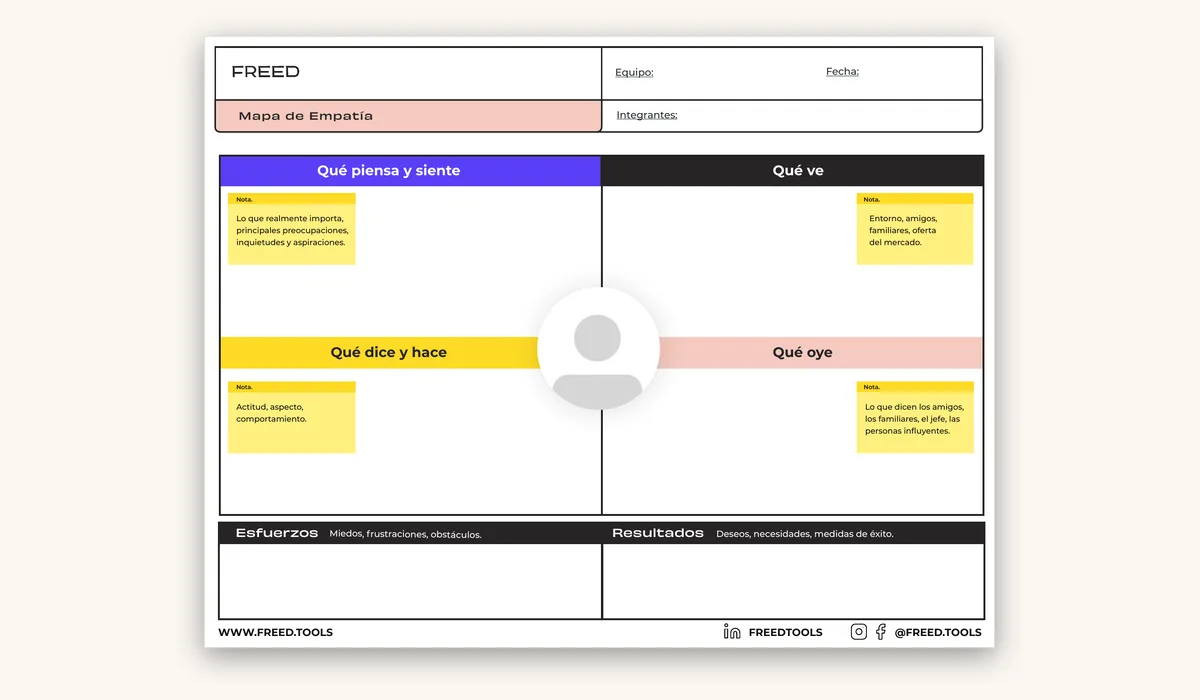
Empathy Map: What It Is and How to Complete It
Discover what an empathy map is, its quadrants, what evidence to use, and the most common mistakes when completing it with your team.
Read the guide
Stakeholder Map: Identifying Key Players in a Service
The stakeholder map identifies all individuals and organizations that influence a service. Learn how to build it, understand relationships, and leverage it for future use.
Read the guide
Field Observation: Researching Without Interviewing
Field observation reveals what interviews don't capture. This guide covers observation protocols, how to record findings, and biases to control.
Read the guide
Desktop walkthrough: prototyping services
Desktop walkthrough is a prototyping method that simulates a service using figures and paper. Materials, steps, and when to use it in your workshops.
Read the guide
Organize Your Work with the Activity Analysis Template
The Activity Analysis Template helps you organize your work. Improve your personal and professional productivity. Identify your essential tasks and learn to delegate.
Read the guidePrioritization Matrix: Impact vs. Effort
From dozens of ideas to a handful of bets: how to score alternatives with explicit criteria, model the business on a single page, and take validation to the field with design kits.
Lean Canvas vs. B2B Lean Canvas: Which One to Use
Compare the classic Lean Canvas and the B2B Lean Canvas block by block and discover which one is suitable for your business model.
Why You Should Use a Design Kit in Your Lean and Agile Development Courses
A lean methodology design kit streamlines work on your innovative projects and courses. Get tools that help you bring creative ideas to life.
The Benefits of Using the Design Kit in User Research Courses
Discover the design kit for user research. Created for consultants and instructors who conduct UX Research courses or workshops.
Get more guides like this one
We publish analysis and practical guides on user research, customer experience and digital business. Subscribe and we will let you know with every edition.
No spam. Unsubscribe anytime.